Bio
Hey, I’m Josh, the friendly face behind Veggie Vagabonds which I run with my partner Sarah. If there’s one vegan destination that I never stop blabbering on about it’s Sri Lanka – I’ve been seriously hungry the whole time writing this! I hope you enjoy the tips and if you want to find more information about sustainable travel or ethical eating then you can find us on www.veggievagabonds.com
Vegan Travel Tips in Sri Lanka
Some people travel for culture, some for architecture and others for exhilarating outdoor experiences. I travel for a huge culmination of reasons but top of that list is for food, and not just any food, delicious vegan food. This hunger has taken me all over the world and one of the places that will always stick in my memory is Sri Lanka.
Sri Lanka is home to some of the most fantastic vegan dishes you’ll come across, from sizzling curries, to tangy chutneys and exotic fruits – the food is everywhere and it’s out of this world. Unfortunately it’s not a completely perfect picture, there are plenty of exquisite dishes but as a vegan there are also a lot of things you need to watch out for.
To make sure you’re a happy healthy vegan across the whole of the island here are some of my most important tips. I spent three months covering every inch of the country and chomping all the vegan food possible, so rest assured, you’re in safe hands!
All you need to do is ask
Sri Lankans are (generally) very friendly and helpful which makes life as a vegan a whole lot easier. If you have any queries about dishes and ingredients then all you need to do is ask. English is widely spoken so it’s very straightforward and even in the most remote of places it’s rare to come across an eatery with no English speaking workers.
If you’re unsure of any of the foods, menus or dishes then ask one of the workers – I was often taken into the kitchen and got to speak with the chefs which was always a nice experience. Because the vast majority of food are made fresh and on-site then kitchens are usually very knowledgeable of the ingredients and can add or take out bits and bobs to your preference.
Religions are your friend
The ease of ordering vegan dishes and communicating with kitchens is probably due to the fact that Sri Lankans are very used to dietary restrictions as a diverse religious country. The biggest proportion of people are Buddhist and there are also big communities of Hindus and Muslims. Whilst they may not be vegan themselves they all have their own dietary guidelines and are accustomed to fitting in with others. Because of this around the island you’ll find that all types of dietary choices are respected and honoured.
There is no ‘vegan food’ in Sri Lanka
Wait, there’s no vegan food in Sri Lanka?
Despite the first few tips there is very little vegan food in Sri Lanka, and, if you go into a eatery and ask for vegan food you’ll likely be greeted with blank stares and confused smiles. Before I put you off completely, this is only because the term vegan isn’t widely used or understood. The country IS filled with delicious plant based food, but for the most part it’s just food which doesn’t contain meat, not a specifically vegan dish.
Fear not, remembering the first two tips all you need to do is explain the things you don’t want to eat e.g ‘no fish, no meat, no dairy, no eggs’. Yes, it would be easier if things were labelled as vegan but it’s not the end of the world. It is actually a nice excuse to start a dialogue with some of the locals and enquire about the food. Many people will be interested in your choice of morals so expect some inquisitive questions!
Know the nasties to look out for
And what are the things to look out for?
The main culprits are ghee, shrimp paste, dried fish and milk powder. As we mentioned above all you need to do is ask to see if a dish contains any of these guys, don’t expect it to be labelled.
Unfortunately ghee is sometimes used to fry breads and occasionally for curries and other dishes. Cooking with ghee is more expensive than oil, so if you’re eating local options you don’t need to worry as much.
Shrimp paste is added to some chutneys, sambols and curries however it’s rarely put into vegetable curries. Coconut sambol, which is eaten all over the country and is bloody delicious, is sometimes made with shrimp paste so ask to check.
Dried fish is another frustrating one however it’s normally added as a garnish and is therefore easy to see and avoid. With most of the ingredients you’ll be avoiding as a vegan they’re considerably expensive by local standards so it’s less likely you’ll be given it by accident.
The last culprit, and probably the most frustrating, is milk powder. As a vegan you’ll know that milk powder can get in the most unlikely of places but in Sri Lanka they sometimes really spoil the fun by putting it in coconut milk. Coconut milk is used for a large number of curries and traditional dishes so you need to ask to make sure.
Embrace fresh fruit
Sri Lankan food is rich and very filling, so unless you want to eat rice and curry all day everyday (like me!) fruit can be your best friend. Nowhere is this best friend better than in Sri Lanka as the exotic fruit on offer is diverse, cheap and beautifully tasty. On the island you’ll find huge amounts of coconuts, pineapple, star fruit, jackfruit, mangosteeen, rambutan, avocado… the list goes on and on.
As very little food is imported most of the fruit you’ll find will be seasonal and the prices will vary. I travelled through Sri Lanka in the middle of mango season and it was paradise! Fruit is sold everywhere from large markets to roadside traders but you will need to get haggling to find a good price. My advice is to find the going rate from some of the locals or your accommodation and never accept the first price!
Don’t judge a book by it’s cover
Although this is a good rule for all countries, this is especially true for Sri Lanka. If you judge any eatery by it’s appearance you’re going to miss out on some of the treasures of the country.
Don’t go expecting Western style cleanliness, fine dining and impressive interior design – that’s not Sri Lanka. Sri Lanka is eating a plate of sensational curry from a small hut in the middle of nowhere, or tucking into a masala dosa in a busy Pure Veg restaurant next to a Hindu temple in the North. In complete honesty the most incredible food I tried was normally from the most unlikely of places – it made it all the more exciting!
Bearing this in mind it’s rather fortunate that food hygiene is actually quite good. It’s not as good as parts of Europe or North America but it’s a damn sight better than parts of India and the Middle East. As a vegan you’re already avoiding most foods you would need to be wary of but this is another reason to pick busy eatery – with a high turnover of customers you can guarantee the food is fresh. Altogether you can relax and try everything on offer so you won’t be questioning every slight tummy grumble you get.
Follow some crowds, avoid others.
Another one which I tend to stick by when travelling – steer away from the tourist crowds and toward the local crowds. After 3 months of adventuring in Sri Lankan I ate in a touristy restaurant once and it was by far the worst culinary experience I had.
Tourist orientated restaurants may seem like a ‘safe’ option but for the most part this isn’t the case. Generally the kitchens will be in exactly the same state as local places but just offering a watered down menu with watered down dishes. On top of this the prices will be much higher.
If you want to experience real Sri Lankan food then you need to follow the locals – they know where all the good stuff is. Pick a busy place and the food will be fresh and filled with so much flavour you won’t know what to do. In my experience there was also no benefit for vegans going to a touristy restaurant. In some countries it can prove easier to explain dietary restrictions but all the local spots in Sri Lanka were more than good enough.
Look for temples
I mentioned earlier that Sri Lanka is home to large communities of Hindus and this is great news for us vegans! The majority of Hindus follow a Pure Veg diet, which is a vegetarian diet minus eggs. In areas with larger Hindu populations you’ll find many Pure Veg restaurants, which are not completely vegan but have a huge variety of vegan options.
In the North and East of the country there is a much bigger Indian influence and you’ll definitely notice this during your visit. With these Indian communities come many more Pure Veg spots and commonly if you see a Hindu temple a Pure Veg restaurant will be close by.
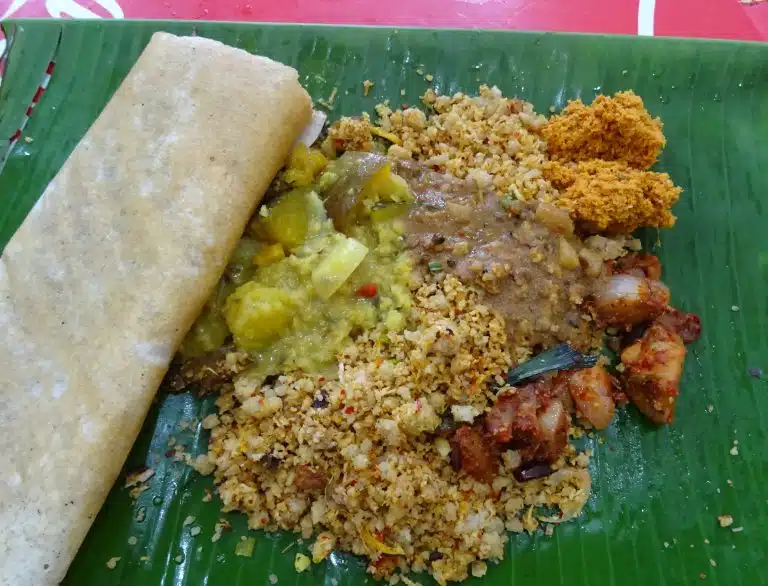
These places are home to some of my favourite foods on the island and I think you’ll love it too. Dhosas, banana leaf thalis, blistering sambols, cooling chutneys and a baffling variety of curries. It’s all so damn tasty but probably my favourite addition is the buckets of curries and chutneys they have on the table which you can help yourself too!
Make a checklist
With all the delicious foods on offer you really should make a list. Write down all of the foods you really want to try and don’t leave the country without ticking them all off! If I could give three suggestions it would be a masala dhosa, some jackfruit curry and pumpkin curry!
Vegan Travel Tips in Sri Lanka
Now you’ve got the knowledge are you ready to go? I’m confident that if you try even a slice of the foods I experienced in Sri Lanka then you’ll be blown away. As a vegan you will truly have a sublime time but follow these tips and you’ll be able to explore every inch of the country. Just remember, when in doubt ask and perhaps go with some loose fitting trousers!